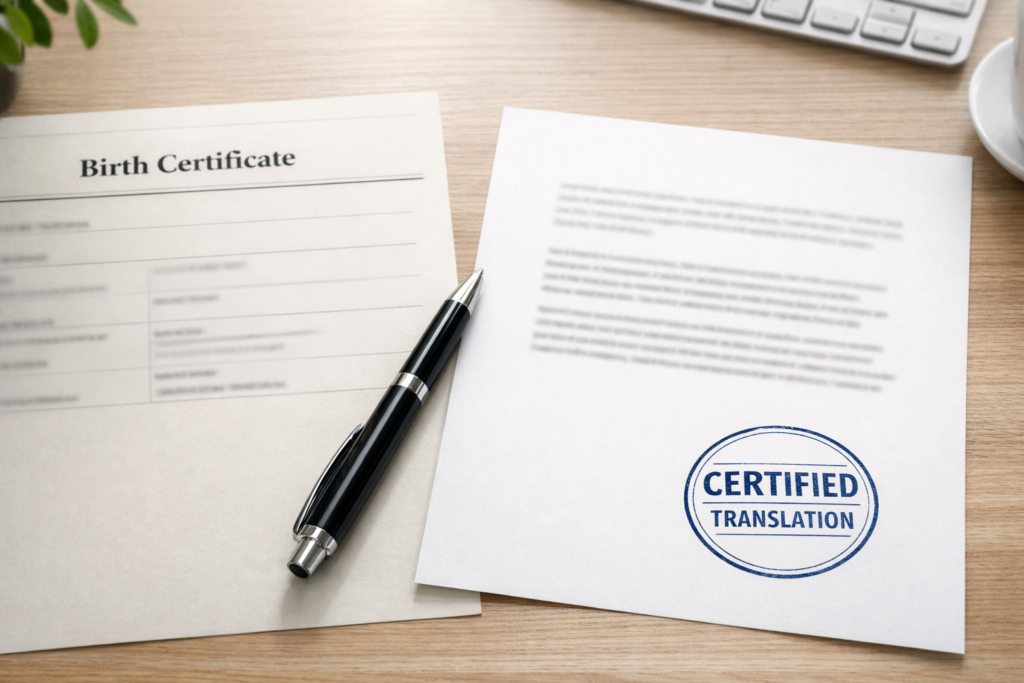
Birth certificate translation sounds simple until an embassy, university, or immigration office rejects it for a missing stamp, a wrong date format, or “incomplete translation”.
This guide shows you exactly how to translate a birth certificate the right way—step by step—so it’s clear, complete, and ready to submit the first time.
If you want us to handle it for you, you can start here: Certified translation services.
How can I get a birth certificate translated for a UK visa application?
If your birth certificate is not in English or Welsh, you will usually need to submit it with a certified translation for a UK visa application.
The safest way to do that is to:
- send a clear scan or photo of the full birth certificate
- request a certified translation, not an informal or summary translation
- make sure every visible part of the document is covered, including stamps, seals, handwritten notes, and reference numbers
- check that names, dates, and places match the rest of your application documents
- receive a signed and dated translation with the translator’s or translation company’s contact details
For most UK visa applications, a certified translation is the key requirement. Notarisation or apostille is not usually the starting point unless a separate authority or process specifically asks for it.
If your birth certificate is already in English, or is bilingual and clearly includes English, you may not need a separate translation. If it is only partly bilingual or contains stamps, notes, or handwritten sections in another language, it is still safest to have the non-English content professionally translated.
Birth certificates are commonly used to prove identity, date of birth, or family relationship in immigration and visa matters, so accuracy matters far more than appearance. A simple omission—such as a stamp, side note, or parent detail—can create delays.
When do you need a birth certificate translation?
You’ll usually need a translated birth certificate for:
Immigration and visas (family visas, residency, citizenship, settlement applications)
Passports and nationality matters (first passport, dual citizenship, registration)
Marriage, adoption, and legal procedures
University admissions and credential checks
Work and HR onboarding (especially overseas employers)
Court and solicitor requests (where identity and family relationship must be evidenced)
If the receiving organisation can’t read the language on your certificate, they’ll typically ask for a complete translation plus a certification statement (and sometimes notarisation or legalisation).
Before you translate anything, confirm these 6 requirements
Different authorities have different rules. Before you pay for a translation, confirm:
Target language (e.g., English for USCIS; English/Welsh for UK bodies; local language for certain countries)
Type of translation required
Standard (informal)
Certified (most common for official use)
Notarised (only if specifically requested)
Apostilled/legalised (for international document acceptance)
Sworn translation (required in some countries, not all)
Whether a digital PDF is accepted or you need a printed hard copy
Deadline (standard vs urgent service)
Do they want the original attached/bound to the translation?
Name spelling rules (must match passport, including spacing, hyphens, and transliteration)
If you’re unsure, upload the requirement note (or tell us where you’re submitting it), and we’ll align the format for you. Contact us to start.
UK visa application quick-check
If you are ordering a birth certificate translation for a UK visa application, confirm these extra points before you proceed:
- Is the full certificate readable, including side notes, stamps, seals, and handwritten entries?
- Are you using the correct version of the certificate, especially if a long-form version is available?
- Does the spelling of names match the passport and the rest of your visa documents?
- Do you want a digital PDF for upload, a printed copy for your records, or both?
- Are you submitting related documents at the same time, such as a marriage certificate, passport copy, or adoption record, that should follow the same spelling and date style?
These small checks reduce the chance of your application being delayed because one supporting document uses a different spelling, is missing a page, or has an incomplete translation.
The birth certificate translation process (step-by-step)
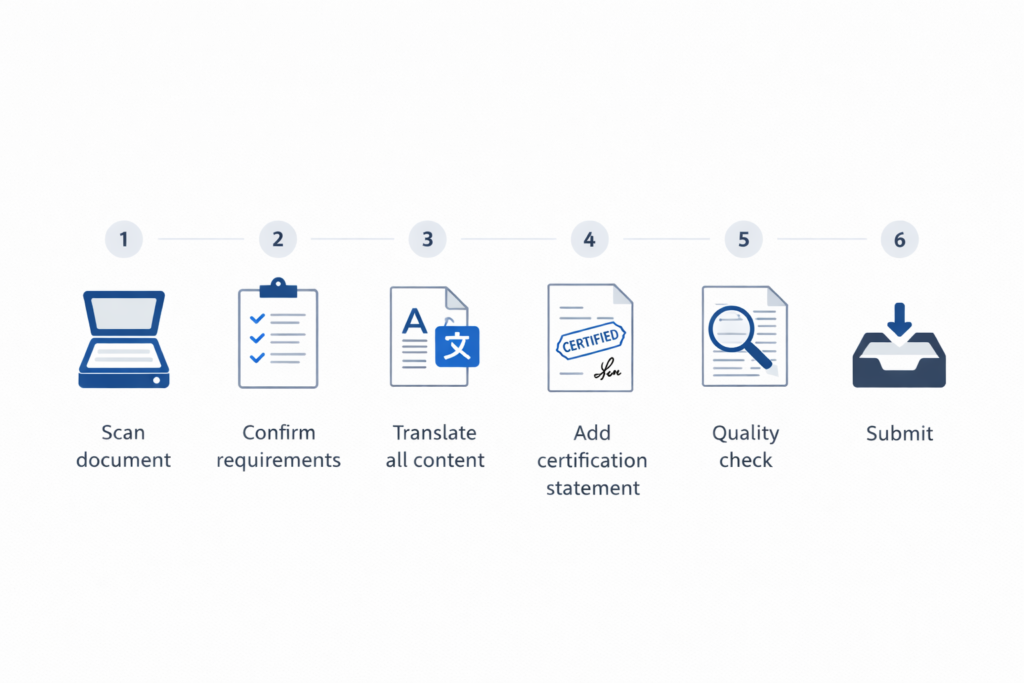
Step 1: Make sure you have the right birth certificate version
Many countries issue multiple versions (short-form, long-form, extract, full register copy). The safest option for official purposes is usually the version with the most detail.
Before you translate, check that the certificate includes (as applicable):
Full name (and any name changes)
Date and place of birth
Parent(s) names and details
Registration number/document number
Issuing authority and seal/stamp
Any marginal notes or amendments
If the authority asked for a specific version (for example, “long-form”), follow that instruction exactly.
Step 2: Create a clean, readable scan or photo
A perfect translation can still be rejected if the original copy is unreadable.
Use this quick capture checklist:
Photograph on a flat surface with even lighting
Capture all corners and edges
Avoid shadows, glare, and blur
Include the back page if there’s text, stamps, barcodes, or notes
If it’s multi-page, keep pages in the correct order
Tip: A phone photo is usually fine as long as it’s readable.
Step 3: Decide what “counts” as part of the translation
A birth certificate translation must be complete. That means translating every visible element that carries meaning, including:
Headings and labels (e.g., “Place of Birth”)
Stamps, seals, and embossing (described clearly if not readable)
Handwritten notes and amendments (if legible)
Registration numbers, reference codes, and issuing office details
Marginal notes and side text
Barcodes/QR codes (often noted as “barcode/QR code present” if not translatable)
Leaving out a stamp or note is one of the fastest ways to trigger a “please resubmit” request.
Step 4: Choose the right translator (and avoid the risky options)
For official use, a casual translation from a friend—or a machine translation—often causes problems.
A submission-ready provider should:
Use a qualified translator fluent in both languages
Keep formatting easy to compare against the original
Include a proper certification statement (signed and dated)
Run a quality check for names, dates, and completeness
Self-translation can create avoidable risk, especially when the document proves your eligibility (immigration, citizenship, family relationship). An independent professional translation is far easier to defend.
Step 5: Provide “identity matching” notes upfront
Birth certificates frequently cause issues because names and dates must match other documents.
When you submit your certificate for translation, tell the translator:
The spelling format you use on your passport/ID
Whether you use middle names, double surnames, or patronymics
Your preferred date format (and what the authority expects)
Any known variations (e.g., accent marks, hyphens, spacing)
This reduces the “small mismatch” problems that delay applications.
Step 6: Translation and formatting (what “good” looks like)
A strong birth certificate translation is designed to be checked quickly by an officer reviewing it against the original.
It should:
Mirror the structure so fields are easy to match
Clearly label stamps/seals and placement
Keep consistent formatting for dates, numbers, and names
Use translator notes only when necessary (for example, when a term has no direct equivalent)
Step 7: Add the certification statement (this is the non-negotiable part)
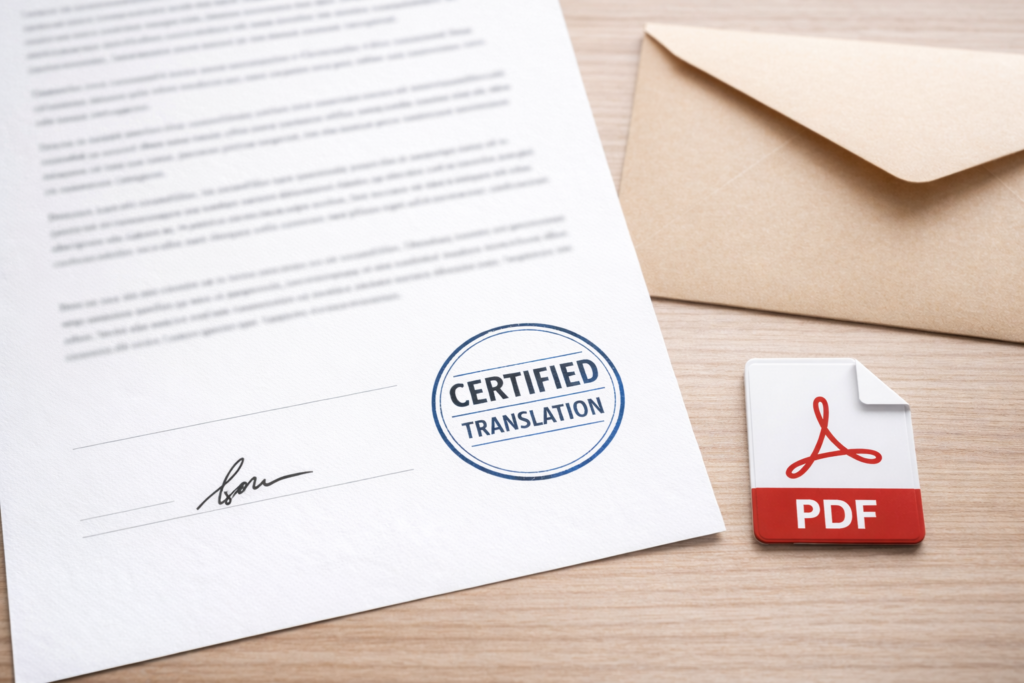
For most official submissions, the translation must include a signed declaration confirming:
The translation is accurate and complete
The translator is competent to translate the language pair
The translator’s name, signature, date, and contact details
Below are two common examples you can share with your provider (the exact wording may vary depending on where you’re submitting it).
Example certification statement (general official use):
“I certify that this is a true and accurate translation of the original document to the best of my knowledge and ability.”
Translator name, signature, date, contact details
Example certification statement (immigration-style wording):
“I, [Name], certify that I am competent to translate from [Language] to English and that this translation is complete and accurate.”
Translator name, signature, date, contact details
If you want a submission-ready certified format without guesswork, start here: Certified translation services.
Step 8: Final quality check (use this submission-ready checklist)
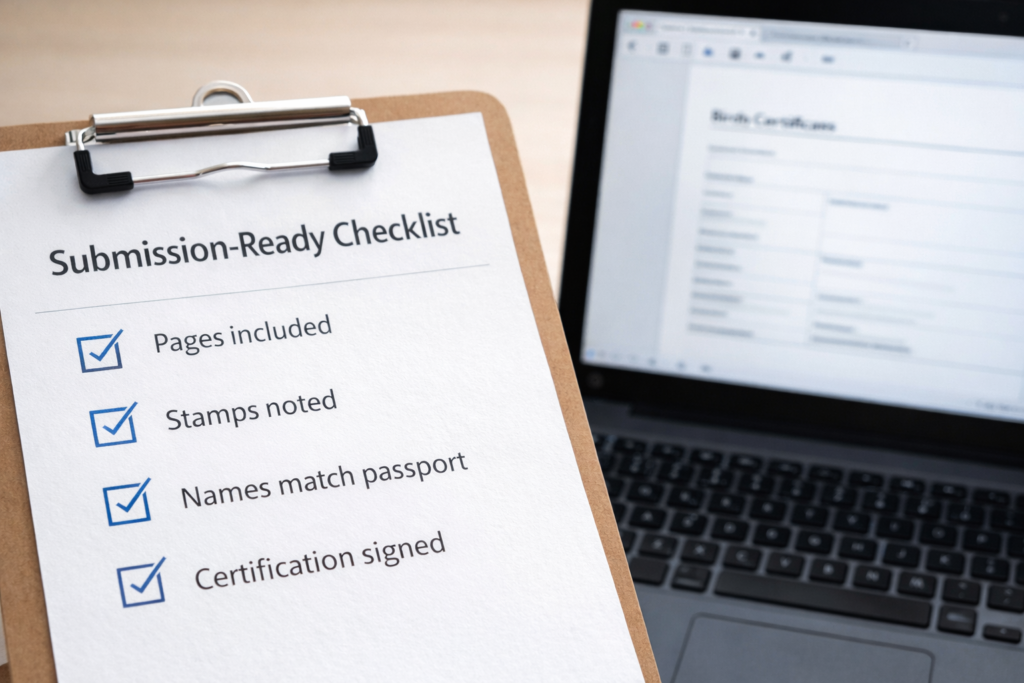
Before you submit, review these high-risk items:
All pages included (front/back, multi-page attachments)
All stamps/seals/notes accounted for
Names match passport spelling and order
Dates are correct and consistently formatted
Places and document numbers match perfectly
Certification statement is present, signed, and dated
Output is clear and easy to compare with the original
If anything looks off—even a missing accent or a swapped surname order—fix it before submission.
What should a UK visa birth certificate translation include?
If you are using your birth certificate for a UK visa application, the safest submission-ready translation will usually include:
- a full translation of all visible non-English text
- the date of the translation
- the full name and signature of the translator or an authorised representative of the translation company
- the contact details of the translator or translation company
- a clear confirmation that the translation is accurate
- enough formatting clarity for an officer to compare the translation against the original document quickly
Where relevant, the translation should also account for:
- stamps and seals
- marginal notes
- handwritten amendments
- registration numbers and issuing authority details
- extra pages, reverse sides, and annexes
If a document is incomplete, missing pages, or not translated clearly enough to be relied on, it can create avoidable delays. For that reason, it is better to order one complete certified translation than to submit a partial translation and hope it is accepted.
Certified vs notarised vs apostilled vs sworn: what do you actually need?
Most people overpay because they order extra steps they don’t need.
Certified translation
Most common requirement for official use. Includes the translation plus a signed certification statement (often issued on letterhead and/or with a stamp).
Notarised translation
A notary verifies the identity of the signer (or witnesses a declaration). Only needed if the receiving organisation explicitly requests it.
Apostille/legalisation
Used for the international acceptance of documents between countries. Typically, a translation must first be properly certified—and in many cases notarised—before it can be apostilled.
Sworn translation
Required in some countries where translators are officially authorised/sworn. If you’re submitting outside the UK/US, check whether the destination country requires sworn translations.
If you tell us where the document is going, we’ll match the correct level of certification so you don’t pay for unnecessary steps. Upload your file here.
Do you need notarisation or an apostille for a UK visa birth certificate translation?
In most UK visa cases, applicants start with a certified translation, not notarisation or apostille.
That is important because many people assume “more official” always means “more acceptable,” but that is not necessarily true. If the visa route only needs a certified translation, adding extra steps can increase cost and processing time without adding any practical value to the application.
If another authority later asks you to use the same document abroad, or to present it outside the immigration context, notarisation or apostille may then become relevant. But for a standard UK visa submission, the first question should usually be: “Do I have a complete certified translation that matches the original document exactly?”
How long does it take to get a birth certificate translated?
Most birth certificates are short documents, so turnaround is often fast—especially when you provide a clear scan and confirm name spelling upfront.
Time depends on:
Language pair (common vs rare)
Whether handwriting, stamps, or multiple pages are involved
Certification method (digital PDF only vs printed copies)
Urgency (standard vs express)
If you have a deadline, include it when you submit, and you’ll get a clear turnaround confirmation: Contact us.
Common mistakes that get birth certificate translations rejected
Avoid these, and you’ll save days (sometimes weeks):
Missing the reverse side, second page, or annex pages
Not translating stamps, marginal notes, or handwritten entries
No certification statement (or missing signature/date/contact details)
Name spelling doesn’t match passport format
Wrong date interpretation (day/month confusion)
Cropped/blurred scans that make fields unreadable
Using machine translation for official submission
Reformatting the document so it’s hard to compare to the original
What if the name on the birth certificate does not match the passport exactly?
This is one of the most common issues in visa and immigration files.
Differences can happen because of:
- transliteration from another alphabet
- maiden names or married names
- double surnames
- patronymics
- accent marks
- spacing or hyphenation differences
- older spellings used on older civil records
The translation should stay faithful to the original document, but the translator should also be told how your name appears on your passport and other application documents. That way, the translation can remain accurate while still being easy for a caseworker to compare with the rest of your file.
If you are submitting more than one translated document, keep the same spelling logic across the whole set. Consistency helps reduce follow-up questions.
Helpful extras that improve acceptance (and reduce stress)
If you’re publishing this page, add one or more of these UX elements for higher engagement:
Downloadable submission checklist (PDF)
One-minute video: “How to photograph your birth certificate correctly”
Mini decision tool: “Do I need certified, notarised, apostilled, or sworn?”
Before/after example: a correctly formatted certified translation sample (with personal data redacted)
Ready to translate your birth certificate?
The fastest, safest way is to use a provider that delivers a complete translation plus the correct certification statement—formatted so it’s easy to verify.
Start here:
Get a certified translation
Upload your birth certificate
FAQ
Do I need a certified translation of my birth certificate?
If you’re submitting it to an embassy, immigration authority, university, or court, you will usually need a certified birth certificate translation with a signed certification statement.
Can I translate my birth certificate myself?
For informal use, sometimes. For official submission, self-translation can create avoidable risk—especially when certification wording, completeness, and formatting must be handled correctly.
What should a certified birth certificate translation include?
A complete translation of every visible element plus a certification statement that confirms accuracy and translator competence, including the translator’s name, signature, date, and contact details.
Do I need a notarised translation for a birth certificate?
Only if the receiving organisation specifically asks for notarisation. Many authorities accept certified translations without notarisation.
Should I translate stamps, seals, and handwritten notes?
Yes. Stamps, seals, and annotations are commonly checked. If something is not legible, a professional translation typically notes that it is present but unreadable.
How do I make sure my birth certificate translation is accepted?
Use a clear scan, ensure every page and stamp are included, match the name spelling to your passport, and include a signed certification statement. A submission-ready checklist review prevents most rejections.
How can I get a birth certificate translated for a UK visa application?
If your birth certificate is not in English or Welsh, send a clear copy to a professional translation provider and request a certified translation. Make sure the translation is complete, dated, signed, and includes the translator’s or translation company’s contact details.
Does a UK visa birth certificate translation need to include stamps and seals?
Yes. A complete translation should account for visible stamps, seals, handwritten notes, registration numbers, and other meaningful markings on the document.
Do I need notarisation or an apostille for a UK visa birth certificate translation?
In many UK visa cases, a certified translation is the main requirement. Notarisation or apostille is usually only needed if a separate authority or process specifically asks for it.
Can I use a digital PDF birth certificate translation for a UK visa application?
Many applicants use a digitally certified translation for online submission. It is still sensible to keep a clear copy of both the original document and the certified translation in case you are asked for them again.
Do I need the long-form birth certificate for a UK visa application?
Often, the version with the most detail is the safest choice because it includes parent details, registration data, and official notes. If your instructions mention a specific certificate type, use that exact version.
What if my birth certificate spelling is different from my passport?
Tell the translator before the work starts. Differences in surname order, spacing, accents, or transliteration should be handled carefully and consistently across all documents in your application.